Welcome to our blog! Some of you have already made your way over here for posts about our Referral Rewards Program, Progression Guide, Social Media Contests and more. This is the first in a new series of Blog Posts called “About Camp”. These do not have a strict release schedule, and will be a space where we can share more about the “why” of various camp topics. As much as we are here to have fun taking laps in the park, camp is also a space where youth can develop their off bike skills and have experiences not possible anywhere else!

How Camp Helps Campers Grow

At Highland Camps, we see a lot of value in welcoming new riders to the world of downhill MTB, and the action sports community at large. This is a space that offers high energy, high intensity play without the inherent competition of many other sports. We aim to provide an enjoyable, productive experience to campers through our 3 core values: Safety, Fun and Learning. Safety is critically important to us. Our camp is fully licensed and our staff are thoroughly trained to supervise and support campers during their stay with us. Our coaches are expertly trained in helping riders progress smartly and unlock new skills as they become ready for them. Fun is the reason people join us at Highland, and we hope that everyone finds a reason to smile while they are at camp. When we are safe and having fun, the learning will happen naturally. Riders will develop their skills, campers will learn to advocate for their needs, make new friends and solve problems with bikes and people alike. This process is critical to one of the biggest places for potential growth at camp: confidence and resilience.

Self-Confidence and Resilience
Self-confidence and resilience in the face of challenge are not innate traits. They are skills which can be learned and developed, and then transferred to any part of life. Much like a talented musician can learn a new instrument quickly – someone that knows how to face a new challenge can use that skill in any part of their life. Mountain Biking is an excellent framework for developing these skills, and we seek to leverage this to help campers become better able to tackle challenges at home, in school and more.
Self-confidence is not the trust that you will succeed at any given task. Rather, real self-confidence is the trust that you can succeed at a given task. The difference is small in words, but large when it comes to how we set goals and evaluate our performance. Since self-confidence is trust, it cannot be built without a history of success. Learning how to build that history of success by setting attainable goals, and measuring ourselves by performance rather than outcomes is key. Our coaches are trained to help campers identify realistic short-term goals that help them progress towards their longer-term riding aspirations.
Resilience is defined as the ability to withstand or quickly recover from difficulties. It does not mean that you are never frustrated, or disappointed. It means that you are able to feel these things, and understand that they are not permanent. Many of our counselors are avid mountain bikers. They are able to relate with the campers about the highs and lows of the sport, and share their own stories of struggling, and how they overcame it to reach their goals. Our counselors are trained to talk with campers about challenges in a non-judgmental way, and to focus on how keeping things fun helps the learning come naturally.

Performance Over Outcomes

How we judge ourselves is a critical part of building resilience. To the right, Craig Manning talks about task oriented vs outcome oriented mindsets. Craig defines a task as an action, where an outcome is a result. Tasks are controllable and simple. They are here and now. Outcomes are complicated and often rely on many individual tasks. Consider a musician performing a song. An outcome oriented mindset is focused on putting on a great performance that the crowd will love. One mistake can easily be seen as a failure from this perspective, derailing the performance. A task oriented mindset breaks the song down into many smaller parts. When the musician focuses on these parts in sequence, a single failure is just that. There is no time or reason to dwell on it because you are already on to the next task. Craig’s story of a tennis set does a great job illustrating how this mindset switch can happen in real time, and the impact it can have on performance.
Mountain biking (and downhill mountain biking in particular) is very well suited to developing the healthy perspective that Craig describes in the video above. Firstly, the runs are short. This helps keep challenging times shorter. A critical part of becoming comfortable with challenge is understanding that it isn’t permanent. The lift rides also punctuate these challenges with opportunities to pause and reset or reflect. Riders have frequent breaks where they can reflect on the last run, or even get their mind off of it with unrelated conversation. Secondly, outside of participating in races or other competitions, MTB lacks the immediate pressure of many competitive sports. Most riders can attest that the majority of your time spent on the bike is spent with no pressure placed on any specific run or attempt to be “the one”. There is no timer counting down, no score being kept between teams. Progression is for the sake of progression and this can make it much easier to accept struggle and maintain a healthy, task oriented mindset.

Embracing Uncertainty: Homesickness , Phone Calls and Tech At Camp
Sleepaway camp is a classic “first time away from family” experience. For many children and teens that first trip can be full of nerves, unanswered questions, and just plain old scary thoughts. Our overnight camps run in relatively short 3-6 night sessions (Sunday – Wednesday or Sunday – Saturday). The sessions are short due to the tiresome nature of downhill MTB, but the shorter session also makes camp more approachable for nervous campers and families. Getting comfortable with the unknown is one of the most important parts of building resilience, so we offer our 3-night program (Summer Ride) as a stepping stone towards the full week of AYR Academy. That narrative of success in new and unfamiliar situations is the foundation on which campers can build their self-confidence.
This brings us to the primary hurdle for overnight campers – Homesickness. This is not going to be a new topic for anyone reading this blog! Everyone has at some point been homesick, or known someone dealing with homesickness. In fact, according to a summer camp study by Dr. Christopher Thurber of Phillips Exeter Academy, 83% of boys between the ages of 8 and 16 reported homesickness on at least one day at camp. Of those cases, only 7% last longer than 2 days and end up negatively impacting participation in camp.
So how can we help campers deal with these feelings and enjoy their time at camp? Firstly, the best thing to do is to stay busy. Homesickness thrives in an idle mind. Feelings of homesickness are most commonly reported to us at lunchtime, during evening routines such as waiting for a turn to shower, and at bedtime. Packing a book, card game or other familiar activity for these times can be a great opportunity to introduce a familiar routine and help with these tricky times. Secondly (and maybe counterintuitively) is to avoid an early phone call, especially on the first night! It is completely natural for the parent to want to come to the aid of their child. It’s also completely normal for a camper to seek the comfort of their parent’s voices. However camp professionals have seen time and again that doing this too early can just reinforce the desire to leave camp and be at home. We find that the best thing to do is wait it out. Usually campers will settle in over the course of the first day of riding and be so caught up in the new friends and camp activities that the thought doesn’t cross their mind. For the campers who continue to struggle, our policy is to keep calls short and sweet. Most often we will schedule the first call home for a lunch or snack break during riding time. By doing this we put a natural time limit on the call. The best first phone call will contain a chat about the riding so far, some questions about life at camp, and positive reinforcement – before your camper hurries off the phone to grab a snack and rejoin their group for more riding!
This entire strategy relies on our ability to manage when parent communication is available. Which brings us to our electronics policy. Highlands Camps are phone free. This can feel like a big challenge for campers and families who have grown together with a great level of connection. However for all of the ways that phones are wonderful, they can also get in the way of camp. Phones often act as a security blanket in new and unfamiliar environments. Why make new friends if you can text your friend from home? Why ask a staff member for help with a troublesome roommate when you can just play a game and ignore them? These aren’t imaginary scenarios either. Plenty of camps have tried allowing phones, only to face these very challenges and change course. In fact according to a 2023 study by Immersive1st, 90% of camps have a no phones policy for campers.

You can read about our electronics policy in more detail on our “About” Summer Camp page.

At the end of the day, our goal at Highland Camps is to provide an unforgettable experience that leaves campers better as riders and people. We aim to help build confidence and resilience through mentorship by our coaches and counselors. We hire staff who want to see other people succeed. We work with our campers to help them find growth in challenge, not comfort in avoiding it. Our camp is built with these goals in mind – and will continue to change and grow as we pursue them further.

If you have questions about our program, or want to become a part of the team – feel free to reach out! We are looking forward to another summer of riding, and hope to see you there.

Highland Camps Team
camps@highlandmountain.com
603-731-1499

Highland Summer Camps
Welcome to our blog! Some of you have already made your way over here for posts about our Referral Rewards Program, Progression Guide, Social Media Contests and more. This is the first in a new series of Blog Posts called “About Camp”. These do not have a strict release schedule, and will be a space where we can share more about the “why” of various camp topics. As much as we are here to have fun taking laps in the park, camp is also a space where youth can develop their off bike skills and have experiences not possible anywhere else!

How Camp Helps Campers Grow

At Highland Camps, we see a lot of value in welcoming new riders to the world of downhill MTB, and the action sports community at large. This is a space that offers high energy, high intensity play without the inherent competition of many other sports. We aim to provide an enjoyable, productive experience to campers through our 3 core values: Safety, Fun and Learning. Safety is critically important to us. Our camp is fully licensed and our staff are thoroughly trained to supervise and support campers during their stay with us. Our coaches are expertly trained in helping riders progress smartly and unlock new skills as they become ready for them. Fun is the reason people join us at Highland, and we hope that everyone finds a reason to smile while they are at camp. When we are safe and having fun, the learning will happen naturally. Riders will develop their skills, campers will learn to advocate for their needs, make new friends and solve problems with bikes and people alike. This process is critical to one of the biggest places for potential growth at camp: confidence and resilience.

Self-Confidence and Resilience

Self-confidence and resilience in the face of challenge are not innate traits. They are skills which can be learned and developed, and then transferred to any part of life. Much like a talented musician can learn a new instrument quickly – someone that knows how to face a new challenge can use that skill in any part of their life. Mountain Biking is an excellent framework for developing these skills, and we seek to leverage this to help campers become better able to tackle challenges at home, in school and more.
Self-confidence is not the trust that you will succeed at any given task. Rather, real self-confidence is the trust that you can succeed at a given task. The difference is small in words, but large when it comes to how we set goals and evaluate our performance. Since self-confidence is trust, it cannot be built without a history of success. Learning how to build that history of success by setting attainable goals, and measuring ourselves by performance rather than outcomes is key. Our coaches are trained to help campers identify realistic short-term goals that help them progress towards their longer-term riding aspirations.
Resilience is defined as the ability to withstand or quickly recover from difficulties. It does not mean that you are never frustrated, or disappointed. It means that you are able to feel these things, and understand that they are not permanent. Many of our counselors are avid mountain bikers. They are able to relate with the campers about the highs and lows of the sport, and share their own stories of struggling, and how they overcame it to reach their goals. Our counselors are trained to talk with campers about challenges in a non-judgmental way, and to focus on how keeping things fun helps the learning come naturally.

Performance Over Outcomes

How we judge ourselves is a critical part of building resilience. Below, Craig Manning talks about task oriented vs outcome oriented mindsets. Craig defines a task as an action, where an outcome is a result. Tasks are controllable and simple. They are here and now. Outcomes are complicated and often rely on many individual tasks. Consider a musician performing a song. An outcome oriented mindset is focused on putting on a great performance that the crowd will love. One mistake can easily be seen as a failure from this perspective, derailing the performance. A task oriented mindset breaks the song down into many smaller parts. When the musician focuses on these parts in sequence, a single failure is just that. There is no time or reason to dwell on it because you are already on to the next task. Craig’s story of a tennis set does a great job illustrating how this mindset switch can happen in real time, and the impact it can have on performance.

Mountain biking (and downhill mountain biking in particular) is very well suited to developing the healthy perspective that Craig describes in the video above. Firstly, the runs are short. This helps keep challenging times shorter. A critical part of becoming comfortable with challenge is understanding that it isn’t permanent. The lift rides also punctuate these challenges with opportunities to pause and reset or reflect. Riders have frequent breaks where they can reflect on the last run, or even get their mind off of it with unrelated conversation. Secondly, outside of participating in races or other competitions, MTB lacks the immediate pressure of many competitive sports. Most riders can attest that the majority of your time spent on the bike is spent with no pressure placed on any specific run or attempt to be “the one”. There is no timer counting down, no score being kept between teams. Progression is for the sake of progression and this can make it much easier to accept struggle and maintain a healthy, task oriented mindset.

Embracing Uncertainty: Homesickness , Phone Calls and Tech At Camp
Sleepaway camp is a classic “first time away from family” experience. For many children and teens that first trip can be full of nerves, unanswered questions, and just plain old scary thoughts. Our overnight camps run in relatively short 3-6 night sessions (Sunday – Wednesday or Sunday – Saturday). The sessions are short due to the tiresome nature of downhill MTB, but the shorter session also makes camp more approachable for nervous campers and families. Getting comfortable with the unknown is one of the most important parts of building resilience, so we offer our 3-night program (Summer Ride) as a stepping stone towards the full week of AYR Academy. That narrative of success in new and unfamiliar situations is the foundation on which campers can build their self-confidence.
This brings us to the primary hurdle for overnight campers – Homesickness. This is not going to be a new topic for anyone reading this blog! Everyone has at some point been homesick, or known someone dealing with homesickness. In fact, according to a summer camp study by Dr. Christopher Thurber of Phillips Exeter Academy, 83% of boys between the ages of 8 and 16 reported homesickness on at least one day at camp. Of those cases, only 7% last longer than 2 days and end up negatively impacting participation in camp.
So how can we help campers deal with these feelings and enjoy their time at camp? Firstly, the best thing to do is to stay busy. Homesickness thrives in an idle mind. Feelings of homesickness are most commonly reported to us at lunchtime, during evening routines such as waiting for a turn to shower, and at bedtime. Packing a book, card game or other familiar activity for these times can be a great opportunity to introduce a familiar routine and help with these tricky times. Secondly (and maybe counterintuitively) is to avoid an early phone call, especially on the first night! It is completely natural for the parent to want to come to the aid of their child. It’s also completely normal for a camper to seek the comfort of their parent’s voices. However camp professionals have seen time and again that doing this too early can just reinforce the desire to leave camp and be at home. We find that the best thing to do is wait it out. Usually campers will settle in over the course of the first day of riding and be so caught up in the new friends and camp activities that the thought doesn’t cross their mind. For the campers who continue to struggle, our policy is to keep calls short and sweet. Most often we will schedule the first call home for a lunch or snack break during riding time. By doing this we put a natural time limit on the call. The best first phone call will contain a chat about the riding so far, some questions about life at camp, and positive reinforcement – before your camper hurries off the phone to grab a snack and rejoin their group for more riding!

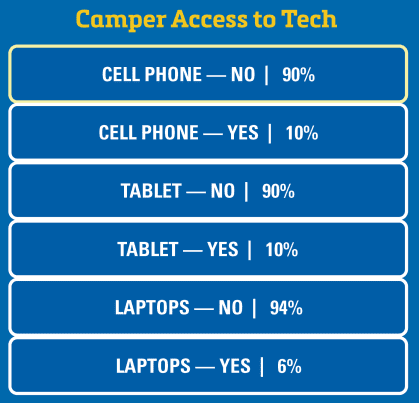
This entire strategy relies on our ability to manage when parent communication is available. Which brings us to our electronics policy. Highlands Camps are phone free. This can feel like a big challenge for campers and families who have grown together with a great level of connection. However for all of the ways that phones are wonderful, they can also get in the way of camp. Phones often act as a security blanket in new and unfamiliar environments. Why make new friends if you can text your friend from home? Why ask a staff member for help with a troublesome roommate when you can just play a game and ignore them? These aren’t imaginary scenarios either. Plenty of camps have tried allowing phones, only to face these very challenges and change course. In fact according to a 2023 study by Immersive1st, 90% of camps have a no phones policy for campers.

You can read about our electronics policy in more detail on our “About” Summer Camp page.

At the end of the day, our goal at Highland Camps is to provide an unforgettable experience that leaves campers better as riders and people. We aim to help build confidence and resilience through mentorship by our coaches and counselors. We hire staff who want to see other people succeed. We work with our campers to help them find growth in challenge, not comfort in avoiding it. Our camp is built with these goals in mind – and will continue to change and grow as we pursue them further.

If you have questions about our program, or want to become a part of the team – feel free to reach out! We are looking forward to another summer of riding, and hope to see you there.

Highland Camps Team
camps@highlandmountain.com
603-731-1499
Highland Summer Camps
CSTsiteisloaded